PID Management: The Registry of Names
A city cannot function without a registry of names. Each citizen is assigned a number, recorded in a ledger, and removed only after their affairs are settled. If a number is reused too soon, confusion follows. The registry clerk must be careful and methodical.
SVR4’s PID management is that registry. It allocates process IDs, maintains a hash for fast lookup, and keeps reference counts so a PID is not recycled while it is still referenced by process groups or sessions.
The Ledger Entry: struct pid
PIDs are represented by struct pid entries stored in a hash table. In os/pid.c the kernel keeps a pidhash array and helper macros (os/pid.c:51-55).
#define HASHSZ      64
#define HASHPID(pid) (pidhash[((pid)&(HASHSZ-1))])
The Registry Buckets (os/pid.c:51-53)
Each pid entry links to a process group list and tracks reference counts and the /proc slot (os/pid.c:41-49, 167-175). The details are scattered in proc_t and the pid structure, but the principle is clear: the pid entry is the registry’s card for that identity.
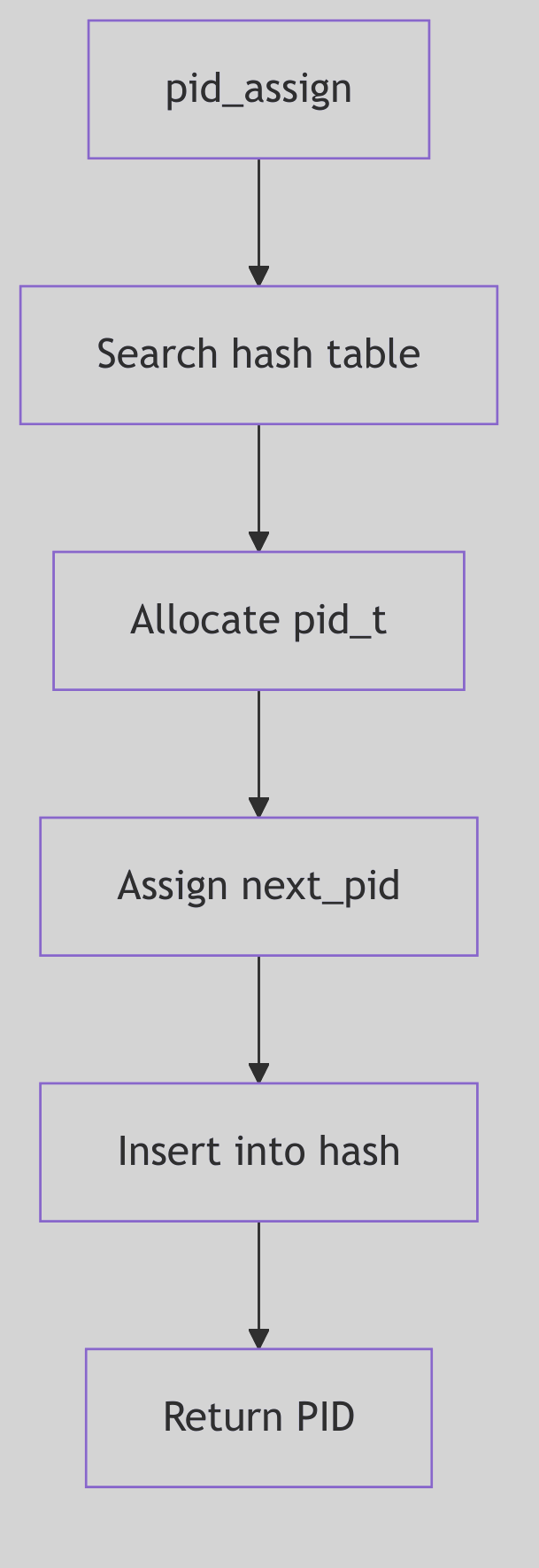 Figure 1.6.1: PID Allocation and Lookup
 PID Management - Registrar’s Office
Assigning a New Name: pid_assign()
pid_assign() handles PID allocation at fork time (os/pid.c:96-182). It enforces process limits, allocates a proc_t and pid structure, and then searches for the next free PID.
if (nproc >= v.v_proc - 1) {
    if (nproc == v.v_proc) {
        syserr.procovf++;
        return -1;
    }
    if (cond & NP_NOLAST)
        return -1;
}
The Capacity Check (os/pid.c:111-118)
PID selection increments mpid, wraps at MAXPID, and skips any PID already present in the hash (os/pid.c:152-155). Once a free PID is found, it is inserted into the hash and linked to the new proc_t.
do {
    if (++mpid == MAXPID)
        mpid = minpid;
} while (pid_lookup(mpid) != NULL);
The Next Free Name (os/pid.c:152-155)
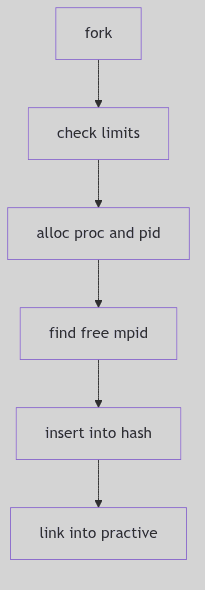 Figure 1.6.2:
 pid_assign() Allocation Path
Reference Counts and Exit
PIDs are shared by process groups and sessions. The registry uses reference counts to keep an ID alive while any structure still points to it. PID_HOLD increments the count; PID_RELE and pid_rele() remove the entry from the hash when the count reaches zero (os/pid.c:188-206).
When a process exits, pid_exit() removes it from the active list, releases its process group and session references, and decrements the PID entry (os/pid.c:212-241). Only after these steps does the PID become available for reuse.
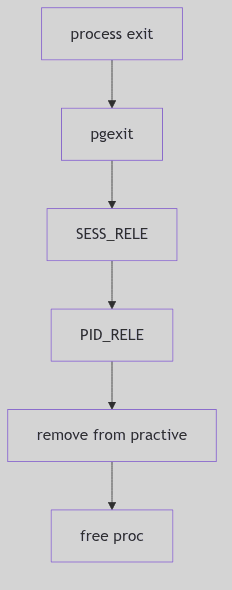 Figure 1.6.3:
 pid_exit() and Release
Lookup and Group Find
prfind() locates a process by PID via the hash and checks whether the slot is active (os/pid.c:248-257). pgfind() does the same for process groups, returning the group’s linked list (os/pid.c:265-276). These lookups are fundamental to signaling, job control, and /proc traversal.
The low-level hash walk is handled by pid_lookup(), which scans a bucket for a matching pid_id (os/pid.c:61-72).
for (pidp = HASHPID(pid); pidp; pidp = pidp->pid_link) {
    if (pidp->pid_id == pid) {
        ASSERT(pidp->pid_ref > 0);
        break;
    }
}
The Registry Lookup (os/pid.c:65-71)
This tight loop is what makes signals and /proc queries fast. The registry is only as useful as its lookup speed.
Minimum PID and /proc Slots
The allocator maintains a moving floor for PID reuse. pid_setmin() advances minpid to mpid + 1 (os/pid.c:75-79), ensuring that recently used PIDs are not immediately recycled. This reduces the chance of PID reuse races in parent/child bookkeeping.
The code also reserves a /proc directory slot for each process. A procent entry is pulled from the free list, linked to the new proc_t, and later returned in pid_exit() (os/pid.c:158-166, 223-227). The registry is thus tied to the /proc filesystem: every PID has a directory entry while it is active.
These two mechanisms keep the ledger consistent: names are not reused too quickly, and visibility in /proc stays in lockstep with process lifetime.
The Ghost of SVR4: We kept a modest hash table and a monotonic counter for IDs. Modern kernels use PID namespaces, per-container ranges, and larger ID spaces, but the registry rule is the same: never reuse a name while someone still holds a claim to it.
The Ledger Closes
PID management is a registry of identities. It assigns numbers, tracks them in a hash, and retires them only when all references are gone. The clerk’s ledger ensures that every process has a unique name and that no name is reused too soon.