The Genesis and Demise of a Process: A Kernel’s Grand Orchestration
The SVR4 i386 kernel, a venerable maestro of multitasking, conducts a perpetual symphony of processes. Each process, from its first breath to its final sigh, embarks on an intricate dance with the kernel’s inner workings. To truly grasp the essence of SVR4—its elegant resource management, its disciplined isolation of execution, and its masterful orchestration of concurrent tasks—one must first become intimately acquainted with this grand lifecycle. We peel back the layers, not merely observing, but feeling the silicon pulse beneath the C logic.
The Spark of Life: Process Creation
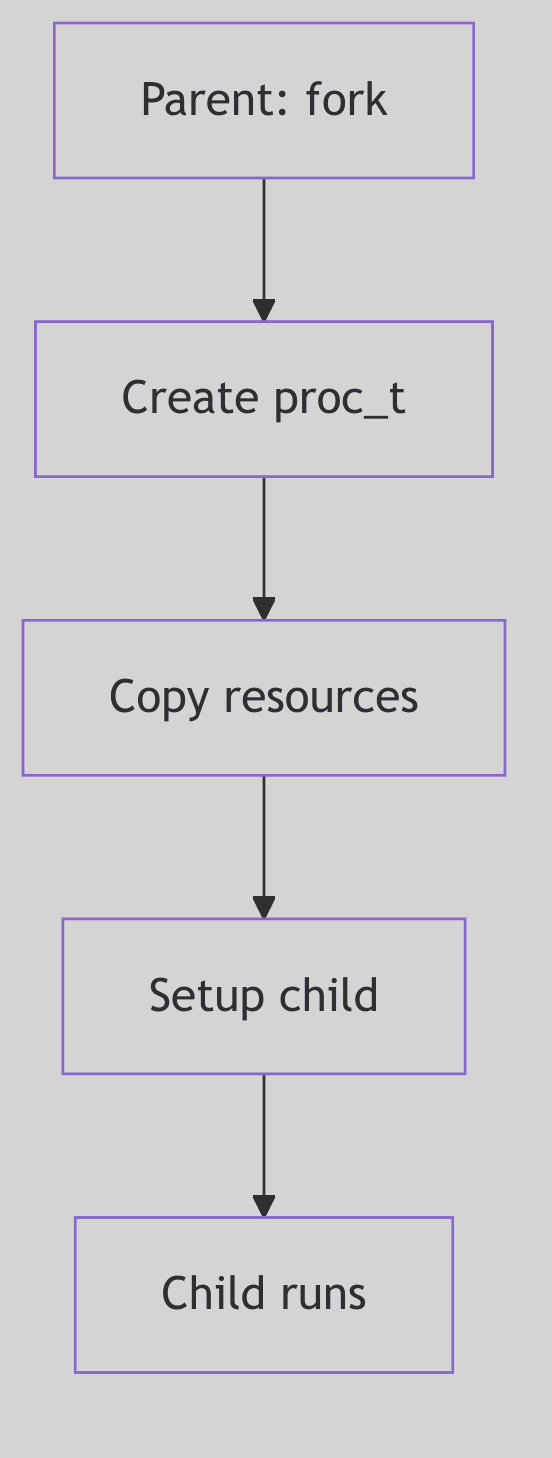 Figure 1.1.1: Fork Process Creation
In the dominion of SVR4, a new process doesn’t simply appear; it is born. The primal act of creation is embodied by the fork() system call—a moment of digital fission where one process, the stoic parent, begets another, the eager child. Imagine, if you will, the kernel as a meticulous scribe, duplicating the parent’s entire universe: its memory segments, its open portals to the filesystem (file descriptors), and even the fleeting thoughts held within its CPU registers.
Upon this miraculous birth, a subtle yet profound distinction emerges. The fork() call, like an oracle, whispers the child’s unique Process ID (PID) to the parent, while to the child, it merely bestows a humble 0, a symbol of its nascent identity.
// A classic fork() scenario in SVR4
#include <unistd.h>
#include <stdio.h>
#include <sys/types.h> // For pid_t

int main() {
    pid_t pid;
    printf("Before fork, PID is %d\n", getpid()); // Line 6

    pid = fork(); // Line 8

    if (pid < 0) {
        perror("fork failed");
        return 1;
    } else if (pid == 0) {
        // Child process
        printf("I am the child! My PID is %d, my parent's PID is %d\n", getpid(), getppid());
    } else {
        // Parent process
        printf("I am the parent! My PID is %d, my child's PID is %d\n", getpid(), pid);
    }
    return 0;
}
Code Snippet 1.1: The Primal fork()
More often than not, this newborn child process hungers for its own destiny, a program distinct from its parent’s. This desire is fulfilled by the exec family of system calls (e.g., execve(), execl()). When an exec call is invoked, the kernel, with swift precision, incinerates the child’s current identity—its code, its data, its very stack and heap—and replaces it with the fresh, crisp image of a new program. Yet, through this metamorphosis, the process’s soul, its PID, remains steadfast, a constant identifier in a changing world.
 Process Lifecycle - Orchestra
fork() vs. vfork(): A Tale of Two Births and Kernel Optimization
But SVR4, ever the pragmatist, offered a sibling to fork(): the enigmatic vfork(). This wasn’t merely a naming convention; it was an optimization born from the austere memory landscapes of 1988. Unlike its memory-duplicating cousin, vfork() was a gambit. The child, rather than receiving its own pristine copy of the parent’s address space, was instead granted temporary stewardship within the parent’s very own address space.
The parent, a benevolent but watchful guardian, would then pause, suspended in time, awaiting the child’s crucial next move: either an exec() to shed its shared skin and embrace its own program, or a swift _exit() to gracefully depart. This daring optimization elegantly sidestepped the heavy toll of copying an entire address space, a true boon when an exec() was imminent.
However, like any daring maneuver, vfork() came with its own perilous tightrope walk. Should the child, in its shared dominion, dare to modify the parent’s address space before its inevitable exec(), chaos could ensue. The kernel, ever vigilant, enforces this strict contract to prevent a child’s nascent scribbles from corrupting the parent’s pristine canvas.
The Ghost of SVR4: Memory Constraints of Yore
In the dimly lit server rooms of 1988, memory was a precious commodity, measured in megabytes rather than gigabytes. The full duplication performed by
fork()—especially for large processes—could be a performance bottleneck.vfork()was a clever, if slightly perilous, solution to mitigate this. It exploited the commonfork()-then-exec()pattern, avoiding an expensive copy that would immediately be discarded.Modern Contrast (2026): Modern
fork()on Linux uses Copy-On-Write: parent and child remain runnable and only incur page copies on write.vfork()still exists, but it retains its historical contract by suspending the parent until the child callsexec()or_exit(). The optimization is now mostly transparent, and the explicitvfork()dance is used sparingly, but the distinction remains: COWfork()preserves parallelism, whilevfork()trades it for speed.
The u-Block: A Glimpse into a Process’s Soul (SVR4 Edition)
Central to the SVR4 process’s identity, beyond its PID, was the venerable User Area, affectionately known as the u-block. This kernel-resident data structure, unique to each process, was a veritable treasure trove of context. It housed the process’s kernel stack, its per-process open file table, signal handling information, error numbers, and a myriad of other critical runtime details. In SVR4 terms, the u-block and the proc table entry together serve as the Process Control Block (PCB): the hardware context lives in the u-block, while system-wide identity and state live in proc.
/* Excerpted fields from struct user (sys/user.h) */
typedef struct user {
	char	u_stack[KSTKSZ];	/* kernel stack */
	char	u_stack_filler_1[2];
	char	u_fpvalid;		/* fp state valid */
	char	u_weitek;		/* uses weitek */
	struct tss386 *u_tss;		/* pointer to user TSS */
	ushort	u_sztss;		/* size of tss */
	ulong	u_sub;			/* stack upper bound */
	proc_t *u_procp;		/* pointer to proc structure */
	int	u_arg[MAXSYSARGS];	/* args to current syscall */
	label_t	u_qsav;			/* longjmp label */
	char	u_error;		/* return error code */
	struct rlimit u_rlimit[RLIM_NLIMITS]; /* resource limits */
	k_sigset_t u_sigonstack;	/* signals on alt stack */
	k_sigset_t u_sigrestart;	/* restart syscalls */
	k_sigset_t u_sigmask[MAXSIG];	/* signals held in catcher */
	void	(*u_signal[MAXSIG])();	/* dispositions */
} user_t;
Code Snippet 1.2: The Intimate u_block (Excerpted)
The Ghost of SVR4: The u-block’s Legacy
The u-block was a cornerstone of SVR4 process management, a compact and efficient way to store per-process kernel context. Its design reflected a time when every byte of memory was carefully accounted for. It served as a critical bridge between the generic
proctable entry (which held system-wide process information) and the specific, rapidly changing context of a process’s kernel execution.Modern Contrast (2026): In contemporary Linux, the concept of a monolithic u-block has evolved. Its responsibilities are now distributed across various fields within the comprehensive
struct task_structand related data structures. While thetask_structin Linux is far more extensive and integrated, the spirit of the u-block—that direct, intimate connection to a process’s ephemeral state—is still palpable within the modern kernel’s design. The SVR4 u-block stands as an elegant predecessor, showing how fundamental information was once encapsulated.
The Final Curtain: Process Termination
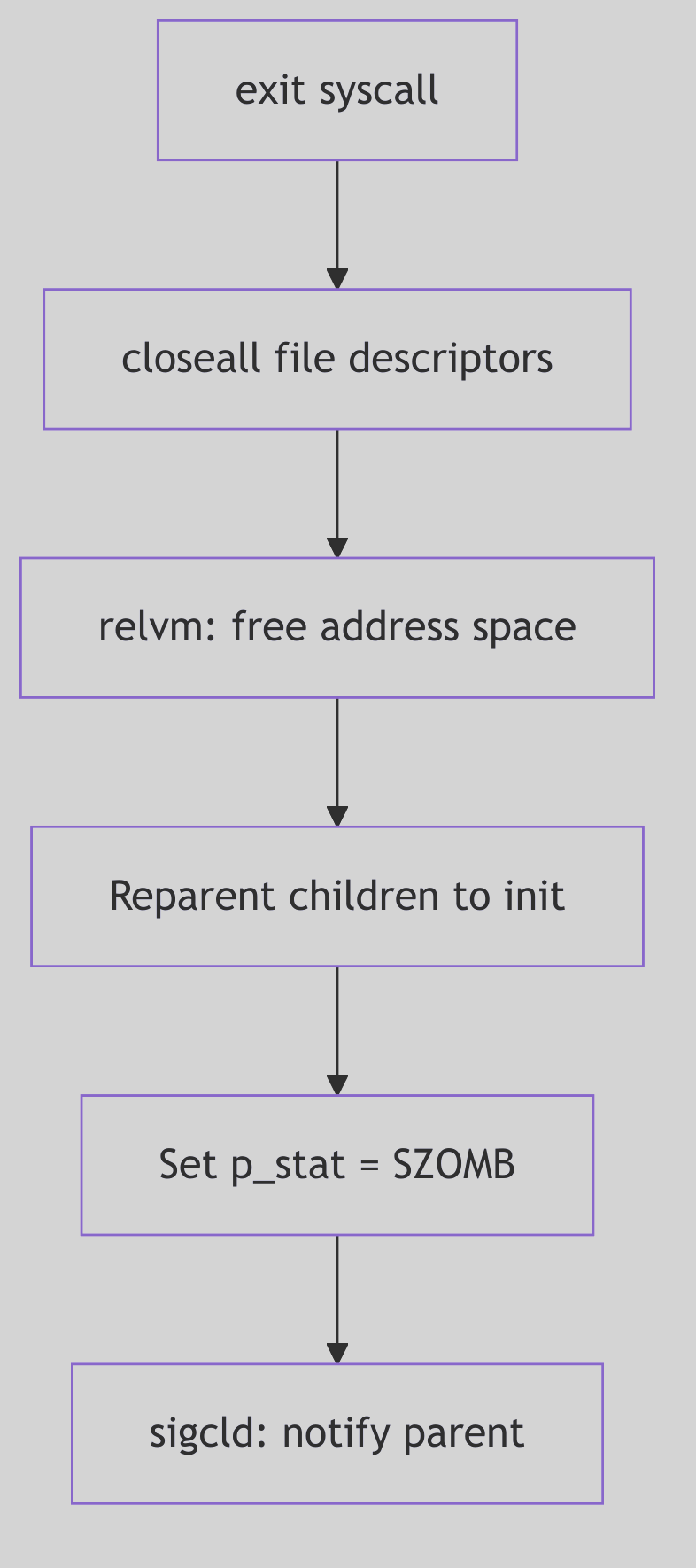 Figure 1.1.2: Process Exit and Termination
Alas, even the most vibrant process must, at some juncture, meet its cessation. This can occur either by graceful self-annihilation or by an unforeseen, often forceful, intervention.
-
Voluntary Departure: A process, having fulfilled its purpose, may choose to exit gracefully by invoking
exit()or_exit(). The_exit()call, a more direct route, bypasses the user-space cleanup routines (likeatexit()handlers orstdiobuffer flushing), making it suitable for children destined for an immediateexec()or for robust error handling where user-space state is untrustworthy. Returning from themain()function in C is, in essence, a call toexit(). -
Involuntary Eviction: The kernel, or another process, can forcibly terminate a process, most often through the delivery of a signal. A
SIGKILL, for instance, is the ultimate, unblockable eviction notice, while aSIGSEGV(segmentation fault) marks a catastrophic misstep in memory access, compelling the kernel to intervene.
Upon termination, a process does not vanish instantaneously. Instead, it lingers as a spectral “zombie” process. In this enigmatic state, its computational essence is gone, its resources largely reclaimed by the kernel. Yet, a vestige remains: its entry in the kernel’s Process Table and its u-block/PCB context, preserved long enough to hold the exit status. This spectral existence serves a vital purpose: it allows the parent process, through the wait() or waitpid() system calls, to collect the child’s final report—its exit status—and only then does the kernel fully expunge the zombie, “reaping” its last kernel resources.
Should a parent process prematurely depart this digital realm before its children, those orphaned processes are not left to wander the wilderness. Instead, they are nobly adopted by the venerable init process (always PID 1), the primordial ancestor of all user-space processes. init, the steadfast caretaker, assumes the responsibility of patiently wait()ing for these adopted children, dutifully reaping their zombie forms when their time comes. This ensures that no process lingers eternally, hogging precious Process Table entries.
The Ghost of SVR4: The Importance of Reaping
Unreaped zombie processes, while consuming minimal resources, can exhaust the finite number of entries in the kernel’s Process Table. In the SVR4 era, this was a tangible risk, capable of leading to system instability by preventing new processes from being created. The
wait()family of calls wasn’t just good practice; it was a necessary ritual to maintain kernel hygiene.Modern Contrast (2026): While modern kernels have larger process tables, the principle remains. Zombie processes, if accumulated in large numbers, can still signify application bugs (e.g., parent processes not
wait()ing for their children) and can indeed consume resources, albeit mostly Process Table entries, which are still finite. Theinitadoption mechanism remains a cornerstone of UNIX-like systems, a testament to the foresight of early designers.
The Dance of Existence: Process States
Throughout its ephemeral existence, a process whirls through a ballet of states, each signifying its current relationship with the CPU and the kernel’s resources. The SVR4 kernel, with its meticulous oversight, maintains a Process Table—a grand ledger of proc structures, each a detailed dossier on a single process. This proc structure is the central repository, containing its PID, its current state, its security credentials, and a web of pointers to other critical kernel data, such as our familiar u-block.
The primary states in this grand choreography include:
- Running: The process is, at this very instant, clutching the CPU, executing its instructions with fervor.
- Ready (Runnable): Poised and eager, the process is perfectly capable of running but is momentarily sidelined, patiently awaiting its turn on the CPU, a hopeful contender in the scheduler’s queue.
- Sleeping (Waiting): The process has temporarily retired from active computation, having voluntarily surrendered the CPU. It slumbers, awaiting a specific event—perhaps the completion of an I/O operation, the arrival of a signal, or the tick of a timer. It’s in a state of suspended animation, ready to awaken when its desired event materializes.
- Zombie: As discussed, this is the spectral aftermath of a terminated process, awaiting its parent’s final rites of
wait()orwaitpid(). - Stopped: A process temporarily frozen in time, usually by an external force—a
SIGSTOPorSIGTSTPsignal—often seen in the graceful mechanics of shell job control. It can be resumed by aSIGCONTsignal.
The Ghost of SVR4: Process Groups and Sessions for Order
The SVR4 kernel introduced sophisticated mechanisms like process groups and sessions not merely as abstract concepts, but as fundamental tools for imposing order on the chaos of multiple processes.
Process Groups are collections of related processes, typically created by a shell pipeline (e.g.,
command1 | command2). Signals, such asSIGINT(Ctrl+C), are often delivered to an entire process group, allowing for collective control. This was crucial for shell job control, enabling a user to suspend (SIGTSTP), resume (SIGCONT), or terminate an entire pipeline of commands with a single keystroke.Sessions elevate this concept further, encapsulating one or more process groups. A session typically corresponds to a login session or a terminal, acting as an insulating layer. When a terminal closes, a
SIGHUPsignal is often sent to the session leader, which can then propagate it to its process groups, gracefully terminating the applications associated with that session. This structured hierarchy was vital for managing interactive user environments and background jobs reliably.
The Kernel’s Hand-Off: Context Switching
The very illusion of concurrency—of many processes seemingly running simultaneously on a single CPU—is conjured by the kernel’s exquisite mastery of context switching. This is the heart of multitasking: the instantaneous, surgical act of preserving the entire operational state of the currently executing process, and then, with equal precision, reinstating the state of another.
When the scheduler, having made its momentous decision, dictates a change, the kernel embarks on a critical, low-level ballet. The CPU’s fleeting memories are meticulously archived:
- General-Purpose Registers: The immediate workspace of the CPU, holding operands and results.
- Program Counter (Instruction Pointer): The CPU’s bookmark, indicating the next instruction to execute.
- Stack Pointer: The current top of the process’s stack.
- Process Status Word (PSW): A register reflecting the CPU’s current operational mode, flags, and interrupt status.
- Memory Management Unit (MMU) State: Crucially, the base register pointing to the process’s page tables (e.g.,
CR3on x86), which defines its unique virtual address space.
This meticulously saved “context” is stored within the process’s proc structure (or its u-block, or a combination thereof), a snapshot awaiting the process’s eventual return to the CPU.
At the core of this resurrection, particularly in SVR4, lies the often-unsung hero: the resume() function.
The resume() Function: Awakening a Slumbering Giant
The resume() function, a highly optimized, architecture-dependent assembly routine, is the incantation that breathes life back into a scheduled process. It is the final, atomic act of the context switch. Its mission: to load the previously saved CPU state of the chosen newproc into the physical CPU registers. On i386 this logic lives in ml/misc.s (ml/misc.s:1339-1370).
In practice, resume() performs the inverse operation of context saving:
- It receives pointers to the
procstructures (or their relevant context saving areas) of theoldproc(the process being switched from) andnewproc(the process being switched to) to save the current CPU state (registers, stack pointer, program counter) ofoldproc. - It updates the kernel’s internal pointers to reflect the currently executing process.
- Crucially, it restores the saved CPU state of
newproc, including itsCR3register to point tonewproc’s page tables, effectively switching the active virtual address space. - It then “returns” into the
newproc’s context, making it appear as ifnewprocwas simply suspended and is now continuing from where it left off.
// Schematic outline for resume() (x86 specific)
resume(oldproc, newproc):
    ; Save oldproc's context (often done by the caller or an interrupt handler)
    ; ...

    ; Switch current process pointers (conceptual)
    mov EAX, newproc_ptr
    mov [current_proc_ptr], EAX ; Update global current process pointer

    ; Restore newproc's MMU context (CR3 register)
    mov EAX, [newproc_page_table_base]
    mov CR3, EAX ; This is where the virtual address space magic happens!

    ; Restore newproc's general purpose registers, stack pointer, and instruction pointer
    pop EBP
    pop ESI
    pop EDI
    pop EDX
    pop ECX
    pop EBX
    pop EAX

    mov ESP, [newproc_kernel_stack_pointer] ; Load new kernel stack

    ; Finally, return to the new process's execution flow
    ret_from_interrupt_or_call ; Jumps to newproc's saved EIP/CS
Code Snippet 1.3: The resume() Function’s Orchestration (Schematic)
The resume() function is an exquisite piece of engineering, often residing at the very boundary between C code and the raw power of assembly. It operates with surgical precision, ensuring that the transition between processes is seamless and efficient, a blink-and-you-miss-it moment that underpins the entire multiprocessing paradigm.
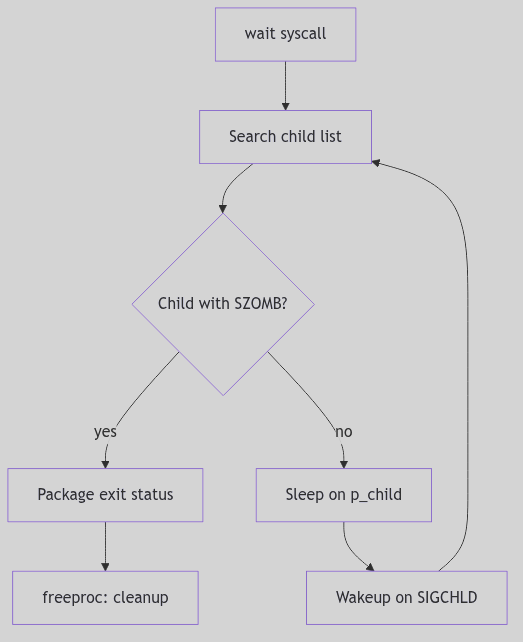 Figure 1.1.3: Wait and Zombie Reaping