Semaphores: The Turnstiles and the Ledger of Debts
Imagine a railway station with a row of turnstiles. Each turnstile has a counter and a small notebook. When a passenger enters, the counter decreases. When a train arrives and empties, the counter increases. The station master can adjust several turnstiles at once, and the entire action is either accepted or rejected as a single transaction.
SVR4’s System V semaphores are those turnstiles. They are integer counters with an atomic operation list, a record of waiting travelers, and an optional debt ledger that is settled when a process leaves the station.
The Semaphore Set Ledger: struct semid_ds
A semaphore set is described by struct semid_ds in sys/sem.h (sys/sem.h:63-71).
struct semid_ds {
	struct ipc_perm sem_perm;	/* operation permission struct */
	struct sem	*sem_base;	/* ptr to first semaphore in set */
	ushort		sem_nsems;	/* # of semaphores in set */
	time_t		sem_otime;	/* last semop time */
	long		sem_pad1;	/* reserved for time_t expansion */
	time_t		sem_ctime;	/* last change time */
	long		sem_pad2;	/* time_t expansion */
	long		sem_pad3[4];	/* reserve area */
};
The Turnstile Ledger (sys/sem.h:63-75)
Each set holds a contiguous array of struct sem entries, allowing multiple operations to be applied atomically in a single semop() call.
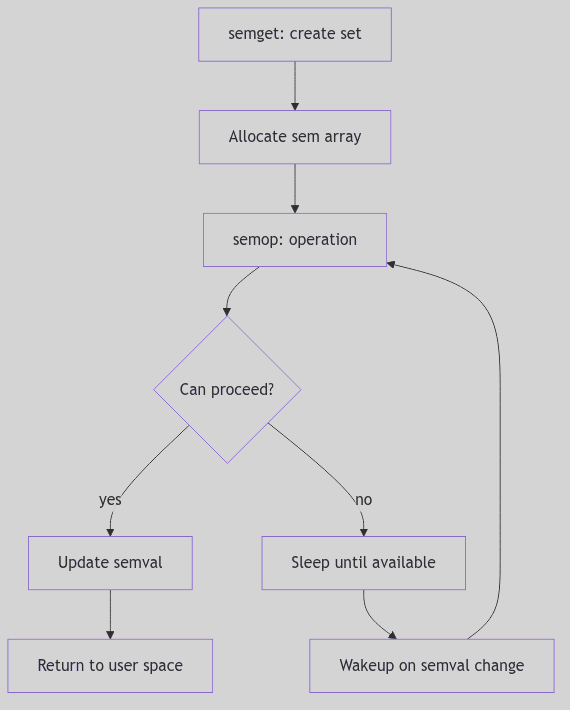 Figure 1.9.1: Semaphore Set and Per-Semaphore State
 Semaphores - Railway Station Turnstiles
The Turnstile: struct sem
Each semaphore maintains its value and the number of waiters for two conditions (sys/sem.h:85-90).
struct sem {
    ushort semval;  /* semaphore value */
    pid_t  sempid;  /* pid of last operation */
    ushort semncnt; /* # awaiting semval > cval */
    ushort semzcnt; /* # awaiting semval = 0 */
};
The Turnstile Record (sys/sem.h:85-90)
semncntcounts processes waiting to decrement (they need more value).semzcntcounts processes waiting for the semaphore to reach zero.
These counters are the clerk’s waiting list; they drive wakeups when state changes.
The Atomic Script: semop() and struct sembuf
A semop() call submits an array of struct sembuf operations (sys/sem.h:180-184). All operations are validated and executed atomically.
struct sembuf {
    ushort sem_num; /* semaphore # */
    short  sem_op;  /* semaphore operation */
    short  sem_flg; /* operation flags */
};
The Operation Slip (sys/sem.h:180-183)
semop() in os/sem.c walks the operation list and applies each step (os/sem.c:665-745). The logic is strict:
sem_op > 0increments the counter, waking waiters if necessary.sem_op < 0decrements if the counter is high enough; otherwise sleep or returnEAGAIN.sem_op == 0waits until the counter reaches zero.
if (op->sem_op < 0) {
	if (semp->semval >= (unsigned)(-op->sem_op)) {
		if (op->sem_flg & SEM_UNDO
		  && (error = semaoe(op->sem_op, uap->semid,
		    op->sem_num))) {
			if (i)
				semundo(semtmp.semops, i, uap->semid, sp);
			return error;
		}
		semp->semval += op->sem_op;
		if (semp->semzcnt && !semp->semval) {
			semp->semzcnt = 0;
			wakeprocs((caddr_t)&semp->semzcnt, PRMPT);
		}
		continue;
	}
	if (i)
		semundo(semtmp.semops, i, uap->semid, sp);
	if (op->sem_flg & IPC_NOWAIT)
		return EAGAIN;
	semp->semncnt++;
	if (sleep((caddr_t)&semp->semncnt, PCATCH|PSEMN)) {
		if ((semp->semncnt)-- <= 1) {
			semp->semncnt = 0;
			wakeprocs((caddr_t)&semp->semncnt, PRMPT);
		}
		return EINTR;
	}
	goto check;
}
The Negative Gate (os/sem.c:675-718, excerpt)
If a later operation fails after earlier ones succeeded, semundo() rolls back the completed steps to preserve atomicity (os/sem.c:672-707). The station master never leaves a partial transaction in the ledger.
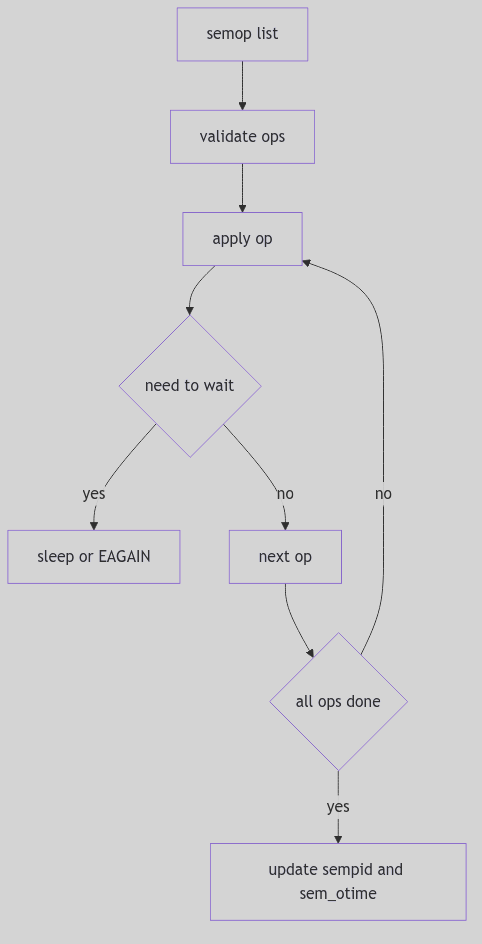 Figure 1.9.2:
 semop() Atomic Evaluation
The Debt Ledger: SEM_UNDO
When a process sets SEM_UNDO, the kernel records an adjustment in a per-process undo structure (sys/sem.h:150-158). This lets the kernel reverse the operation if the process exits unexpectedly.
struct sem_undo {
    struct sem_undo *un_np;
    short un_cnt;
    struct undo {
        short  un_aoe; /* adjust on exit */
        ushort un_num; /* semaphore # */
        int    un_id;  /* semid */
    } un_ent[1];
};
The Debt Ledger (sys/sem.h:150-158)
This mechanism prevents deadlocks caused by process crashes. The station records debts, then settles them at exit so the turnstiles are never left permanently locked.
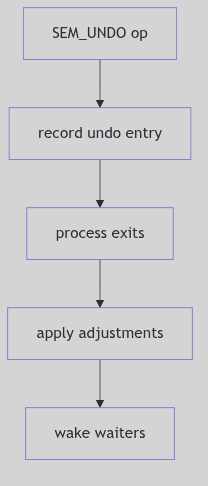 Figure 1.9.3: Undo Tracking on Process Exit
The Ghost of SVR4: We offered atomic arrays of semaphore ops and a built‑in debt ledger for crashes. Modern systems still carry System V semaphores, but many applications now prefer futexes, robust mutexes, and lock‑free queues. The turnstiles are faster now, yet the old rule remains: the ledger must balance, or the station grinds to a halt.
The Ledger Closes
Semaphores in SVR4 are a careful accounting system. Each set has a ledger, each semaphore has waiting lists, and each operation is either fully applied or unwound. The station master keeps every turnstile honest, and the travelers pass through in orderly fashion.