Segment Drivers - VNode
Overview
The seg_vn driver manages file-backed and anonymous memory segments. It handles executable mappings, shared libraries, mmap’d files, and copy-on-write semantics for fork(). The driver supports both MAP_PRIVATE and MAP_SHARED mappings with flexible backing storage.
Segvn Data Structure
The segvn_data structure (seg_vn.h:79) contains per-segment state:
struct segvn_data {
    mon_t lock;
    u_char pageprot;         /* true if per page protections present */
    u_char prot;             /* current segment prot if pageprot == 0 */
    u_char maxprot;          /* maximum segment protections */
    u_char type;             /* type of sharing done */
    struct vnode *vp;        /* vnode that segment mapping is to */
    u_int offset;            /* starting offset of vnode for mapping */
    u_int anon_index;        /* starting index into anon_map anon array */
    struct anon_map *amp;    /* pointer to anon share structure */
    struct vpage *vpage;     /* per-page information */
    struct cred *cred;       /* mapping credentials */
    u_int swresv;            /* swap space reserved for this segment */
};
The vp and offset fields identify the file backing, while amp points to anonymous memory for private pages. The driver can combine file and anonymous backing within a single segment.
Anon Map Structure
The anon_map structure (seg_vn.h:69) manages shared anonymous memory:
struct anon_map {
    u_int refcnt;            /* reference count on this structure */
    u_int size;              /* size in bytes mapped by the anon array */
    struct anon **anon;      /* pointer to an array of anon pointers */
    u_int swresv;            /* swap space reserved for this anon_map */
};
Multiple segments can share the same anon_map for System V shared memory. The reference count tracks sharing, and the entire structure is freed when refcnt reaches zero.
Segment Creation
The segvn_create() function (seg_vn.c:157) establishes a new mapping:
int
segvn_create(seg, argsp)
	struct seg *seg;
	_VOID *argsp;
{
	register struct segvn_crargs *a = (struct segvn_crargs *)argsp;
	register struct segvn_data *svd;
	register u_int swresv = 0;
	register struct cred *cred;
	int error;

	if (a->type != MAP_PRIVATE && a->type != MAP_SHARED)
		cmn_err(CE_PANIC, "segvn_create type");

	if (a->amp != NULL && a->vp != NULL)
		cmn_err(CE_PANIC, "segvn_create anon_map");

	if ((a->vp == NULL && a->amp == NULL)
	  || (a->type == MAP_PRIVATE && (a->prot & PROT_WRITE))) {
		if (anon_resv(seg->s_size) == 0)
			return (EAGAIN);
		swresv = seg->s_size;
	}

	error = hat_map(seg, a->vp, a->offset & PAGEMASK,
		a->prot & ~PROT_WRITE, HAT_PRELOAD);
	if (error != 0) {
		if (swresv != 0)
			anon_unresv(swresv);
		return(error);
	}

	cred = a->cred ? (crhold(a->cred), a->cred) : crgetcred();
	if (a->vp) {
		error = VOP_ADDMAP(a->vp, a->offset & PAGEMASK, seg->s_as,
			seg->s_base, seg->s_size, a->prot,
			a->maxprot, a->type, cred);
		if (error) {
			if (swresv != 0)
				anon_unresv(swresv);
			crfree(cred);
			hat_unload(seg, seg->s_base, seg->s_size, HAT_NOFLAGS);
			return (error);
		}
	}
The function first validates arguments, then reserves swap space for potentially private pages. HAT resources are reserved with initial protections disabling write access to force protection faults for lazy allocation.
Segment Concatenation
Seg_vn attempts to merge adjacent segments with compatible properties (seg_vn.c:237):
if ((seg->s_prev != seg) && (a->amp == NULL) && (seg->s_as != &kas)) {
    register struct seg *pseg, *nseg;

    pseg = seg->s_prev;
    if (pseg->s_base + pseg->s_size == seg->s_base &&
        pseg->s_ops == &segvn_ops &&
        segvn_extend_prev(pseg, seg, a, swresv) == 0) {
        /* success! now try to concatenate with following seg */
        crfree(cred);
        nseg = pseg->s_next;
        if (nseg != pseg && nseg->s_ops == &segvn_ops &&
            pseg->s_base + pseg->s_size == nseg->s_base)
            (void) segvn_concat(pseg, nseg);
        return (0);
    }
Concatenation reduces address space fragmentation and improves efficiency by merging segments with the same vnode, protections, and mapping type.
Operations Vector
The seg_vn driver provides a complete operations vector (seg_vn.c:91):
struct seg_ops segvn_ops = {
    segvn_dup,
    segvn_unmap,
    segvn_free,
    segvn_fault,
    segvn_faulta,
    segvn_unload,
    segvn_setprot,
    segvn_checkprot,
    segvn_kluster,
    segvn_swapout,
    segvn_sync,
    segvn_incore,
    segvn_lockop,
    segvn_getprot,
    segvn_getoffset,
    segvn_gettype,
    segvn_getvp,
};
The segvn_fault operation handles page faults by reading from the vnode or allocating anonymous pages. The segvn_dup operation implements copy-on-write for fork() by sharing the anon_map and marking pages read-only.
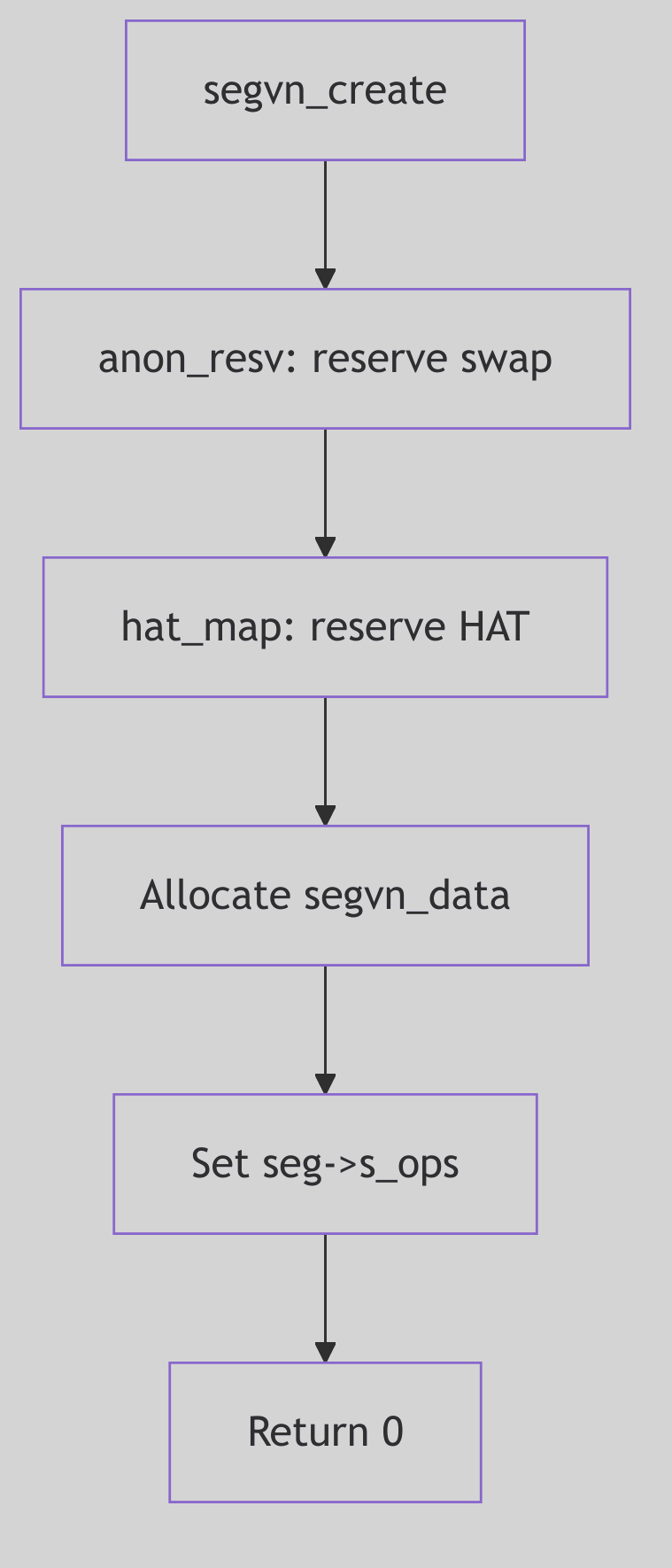 Figure 2.6.1: Vnode Segment Creation